
CLAT Exam Syllabus 2027 with Weightage & PDF Download
Check the CLAT Exam Syllabus 2027 with section-wise weightage, important topics, marking scheme, preparation strategy and PDF download. Understand the five sections of CLAT UG 2027 and plan your preparation effectively.
By Admission Desk
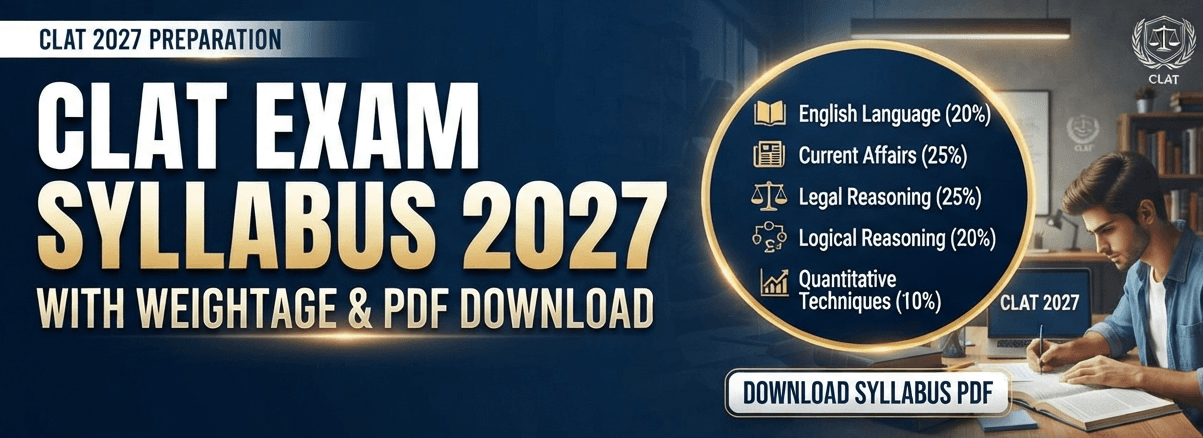
The CLAT Exam Syllabus 2027 is designed to assess the reading, comprehension, analytical, logical and basic mathematical skills required for undergraduate legal education. The CLAT UG 2027 question paper consists of five sections: English Language, Current Affairs including General Knowledge, Legal Reasoning, Logical Reasoning and Quantitative Techniques. The examination contains 120 multiple-choice questions, carries a maximum of 120 marks and has a duration of 2 hours. There is a negative marking of 0.25 marks for every incorrect answer. Understanding the syllabus, section-wise weightage and question pattern can help candidates organise their preparation effectively.
Free Download
CLAT Exam Syllabus 2027 with Weightage & PDF Download
Share your details to get the free brochure delivered as a download.
CLAT Exam Syllabus 2027: Quick Overview
The CLAT 2027 UG examination consists of five sections designed to test comprehension, current affairs awareness, legal reasoning, logical reasoning and quantitative skills.
The CLAT 2027 examination is scheduled for 6 December 2026, according to the official UG notification and instructions.
| Particular | Details |
|---|---|
| Exam Name | Common Law Admission Test (CLAT) 2027 |
| Conducting Body | Consortium of National Law Universities |
| Course | Undergraduate Law Programmes |
| Mode of Exam | Offline |
| Duration | 2 Hours |
| Total Questions | 120 |
| Maximum Marks | 120 |
| Question Type | Multiple Choice Questions |
| Marks per Correct Answer | 1 Mark |
| Negative Marking | 0.25 Mark |
| Total Sections | 5 |
| Mathematics Level | Up to Class 10 |
CLAT 2027 Section-Wise Weightage
The CLAT 2027 question paper covers five main subject areas. The Consortium of National Law Universities specifies an approximate range of questions for each section.
| CLAT 2027 Section | Approx. Questions | Approx. Weightage | Marks Range |
|---|---|---|---|
| English Language | 22–26 | 20% | 22–26 |
| Current Affairs including General Knowledge | 28–32 | 25% | 28–32 |
| Legal Reasoning | 28–32 | 25% | 28–32 |
| Logical Reasoning | 22–26 | 20% | 22–26 |
| Quantitative Techniques | 10–14 | 10% | 10–14 |
| Total | 120 | 100% | 120 |
The number of questions in individual sections may vary within the specified range, while the total paper remains 120 questions.
CLAT English Language Syllabus
The English Language section evaluates a candidate's ability to understand and analyse passages. According to the CLAT UG syllabus, passages may generally be around 450 words and can be based on contemporary or historically significant fiction and non-fiction writing.
Important Topics in English Language
- Reading comprehension
- Main idea of a passage
- Arguments and viewpoints
- Inference-based questions
- Conclusions based on passages
- Summary of passages
- Comparison between arguments or viewpoints
- Meaning of words in context
- Meaning of phrases in context
- Understanding the author's viewpoint
- Identifying important information from a passage
The section primarily focuses on comprehension and interpretation rather than memorising isolated grammar rules.
CLAT Current Affairs and General Knowledge Syllabus
The Current Affairs including General Knowledge section carries approximately 25% of the CLAT 2027 paper. The syllabus states that passages may be based on news, journalistic sources and other non-fiction writing.
Important Topics
- National current affairs
- International current affairs
- Major government policies and initiatives
- Important national and international events
- Awards and honours
- Sports events
- Important personalities
- Arts and culture
- International affairs
- Historical events of continuing significance
- Major developments reported in news
- Important social, economic and political developments
The section may also include questions related to legal information or knowledge discussed in a passage. Additional legal knowledge beyond the passage is not required for such questions.
CLAT Legal Reasoning Syllabus
The Legal Reasoning section is designed to assess how effectively candidates understand and apply principles or rules to given situations. Candidates do not need prior knowledge of law to attempt this section. Instead, questions focus on identifying principles from passages and applying them to different factual situations.
Important Topics for CLAT Legal Reasoning
- Legal principles and rules
- Application of legal principles
- Fact-based legal situations
- Public policy questions
- Moral and philosophical issues
- Identifying rules from passages
- Drawing legal inferences
- Applying rules to new situations
- Understanding changes in rules
- Analysing how changes affect their application
- Contemporary legal issues
- Basic awareness of legal and moral concepts
The section generally requires careful reading and logical application rather than memorisation of large numbers of legal provisions.
CLAT Logical Reasoning Syllabus
Logical Reasoning tests a candidate's ability to understand arguments, identify relationships and evaluate reasoning. The CLAT UG syllabus includes short passages of approximately 450 words followed by questions based on the arguments and information presented in them.
Important Topics
- Identifying arguments
- Identifying premises
- Identifying conclusions
- Understanding relationships between premises and conclusions
- Strengthening arguments
- Weakening arguments
- Evaluating evidence
- Identifying assumptions
- Drawing inferences
- Applying conclusions to new situations
- Analogies
- Contradictions
- Equivalence
- Patterns of reasoning
- Critical analysis of arguments
Students should focus on understanding the structure of an argument instead of simply searching for keywords in the passage.
CLAT Quantitative Techniques Syllabus
The Quantitative Techniques section accounts for approximately 10% of the CLAT 2027 question paper. It tests the candidate's ability to extract and manipulate numerical information presented through short sets of facts, propositions or other textual representations. The mathematical operations are based on concepts up to the Class 10 level.
Important Topics
- Ratios and proportions
- Basic algebra
- Mensuration
- Statistical estimation
- Numerical interpretation
- Data-based questions
- Basic mathematical calculations
- Percentage-based calculations
- Arithmetic operations
- Interpretation of numerical information
The focus is on applying mathematical concepts to information provided in the question rather than solving advanced mathematics problems.
CLAT 2027 Marking Scheme
The CLAT 2027 marking scheme awards one mark for every correct answer and deducts 0.25 marks for every incorrect answer.
Candidates should understand the negative marking scheme while developing their question-attempt strategy.
| Response | Marks |
|---|---|
| Correct Answer | +1 |
| Incorrect Answer | -0.25 |
| Unattempted Question | 0 |
| Total Questions | 120 |
| Maximum Marks | 120 |
How to Prepare for CLAT 2027
A structured preparation strategy can help candidates cover all five sections while improving reading speed, accuracy and time management.
1. Build Reading Habits
Read newspapers, quality news articles, editorials and other reliable sources regularly. This can help improve reading speed and comprehension.
2. Practise Passage-Based Questions
Since several CLAT sections are passage-oriented, practise reading passages and answering questions within a limited time.
3. Prepare Current Affairs Regularly
Instead of trying to study the entire year's current affairs at the last moment, maintain regular notes on important national and international events.
4. Practise Legal Reasoning
Focus on understanding a legal principle and applying it to the facts provided in a question.
5. Strengthen Logical Reasoning
Practise questions involving arguments, assumptions, conclusions, inferences and relationships between ideas.
6. Revise Class 10 Mathematics
For Quantitative Techniques, revise important concepts such as ratios, proportions, basic algebra, mensuration and statistical estimation.
7. Attempt Mock Tests
Mock tests can help candidates understand their speed, accuracy and time-management requirements.
CLAT Syllabus PDF Download
Students preparing for the Common Law Admission Test can use the CLAT 2027 UG syllabus PDF available on this page as a study reference. The syllabus covers all five sections and explains the skills and areas that candidates are expected to prepare.
What the CLAT 2027 Syllabus PDF Contains
- CLAT English Language syllabus
- CLAT Current Affairs and General Knowledge syllabus
- CLAT Legal Reasoning syllabus
- CLAT Logical Reasoning syllabus
- CLAT Quantitative Techniques syllabus
- Section-wise weightage
- CLAT 2027 marking scheme
- Important preparation areas
Candidates should check the official CLAT website for any future changes or updates to the examination pattern, syllabus or schedule.
CLAT UG Syllabus vs CLAT PG Syllabus
CLAT UG and CLAT PG are designed for different admission levels and therefore have different syllabi. The CLAT UG syllabus covers English Language, Current Affairs including General Knowledge, Legal Reasoning, Logical Reasoning and Quantitative Techniques. The CLAT PG syllabus is intended for admission to postgraduate law programmes and focuses on important areas of law relevant to the postgraduate examination.
CLAT UG
- English Language
- Current Affairs including General Knowledge
- Legal Reasoning
- Logical Reasoning
- Quantitative Techniques
CLAT PG
The CLAT PG syllabus focuses on legal subjects and concepts relevant to postgraduate law admission. Candidates should download and follow the syllabus applicable to the programme they intend to join.
Candidates should make sure they are preparing from the correct syllabus according to the undergraduate or postgraduate programme for which they are applying.
Frequently Asked Questions
What is the CLAT Exam Syllabus 2027?
The CLAT 2027 UG syllabus consists of five sections: English Language, Current Affairs including General Knowledge, Legal Reasoning, Logical Reasoning and Quantitative Techniques.
How many questions are there in CLAT 2027?
The CLAT 2027 UG examination contains 120 multiple-choice questions carrying a total of 120 marks.
Is there negative marking in CLAT 2027?
Yes. Candidates receive -0.25 marks for every incorrect answer.
How many marks is CLAT 2027?
CLAT 2027 UG is conducted for a maximum of 120 marks, with one mark awarded for each correct answer.
What is the weightage of Legal Reasoning in CLAT 2027?
Legal Reasoning is expected to contain approximately 28–32 questions, representing roughly 25% of the CLAT 2027 question paper.
What is the weightage of Quantitative Techniques in CLAT 2027?
Quantitative Techniques is expected to contain approximately 10–14 questions, representing roughly 10% of the CLAT 2027 question paper.
Is mathematics compulsory for CLAT 2027?
Quantitative Techniques is one of the five sections of CLAT UG 2027. The mathematical operations tested are based on concepts up to the Class 10 level.
Is legal knowledge required for CLAT Legal Reasoning?
According to the CLAT UG syllabus, prior knowledge of law is not required to attempt the Legal Reasoning section. Candidates are expected to identify and apply principles provided in the passages.
Final Thought
The CLAT Exam Syllabus 2027 focuses on reading comprehension, logical thinking, analytical ability, awareness of current affairs and basic mathematical skills. The CLAT UG examination consists of five sections and 120 questions, with one mark awarded for each correct answer and a negative marking of 0.25 marks for every incorrect answer. Students can plan their preparation by developing reading habits, following current affairs, practising legal and logical reasoning, improving comprehension and revising Class 10-level quantitative concepts. Understanding the section-wise syllabus and approximate weightage can help candidates organise their study plan. Candidates should continue checking the Consortium of National Law Universities website for the latest updates related to the CLAT 2027 examination, syllabus, pattern and schedule. Download the CLAT Exam Syllabus 2027 with Weightage PDF from this page and use it as a reference while preparing for the examination.