
CLAT Exam Syllabus PDF 2027: Download UG & PG Syllabus, Exam Pattern and Preparation Guide
Download the CLAT Exam Syllabus PDF 2027 and explore UG and PG syllabus, subject-wise topics, exam pattern, section-wise weightage, marking scheme and preparation tips.
By Admission Desk
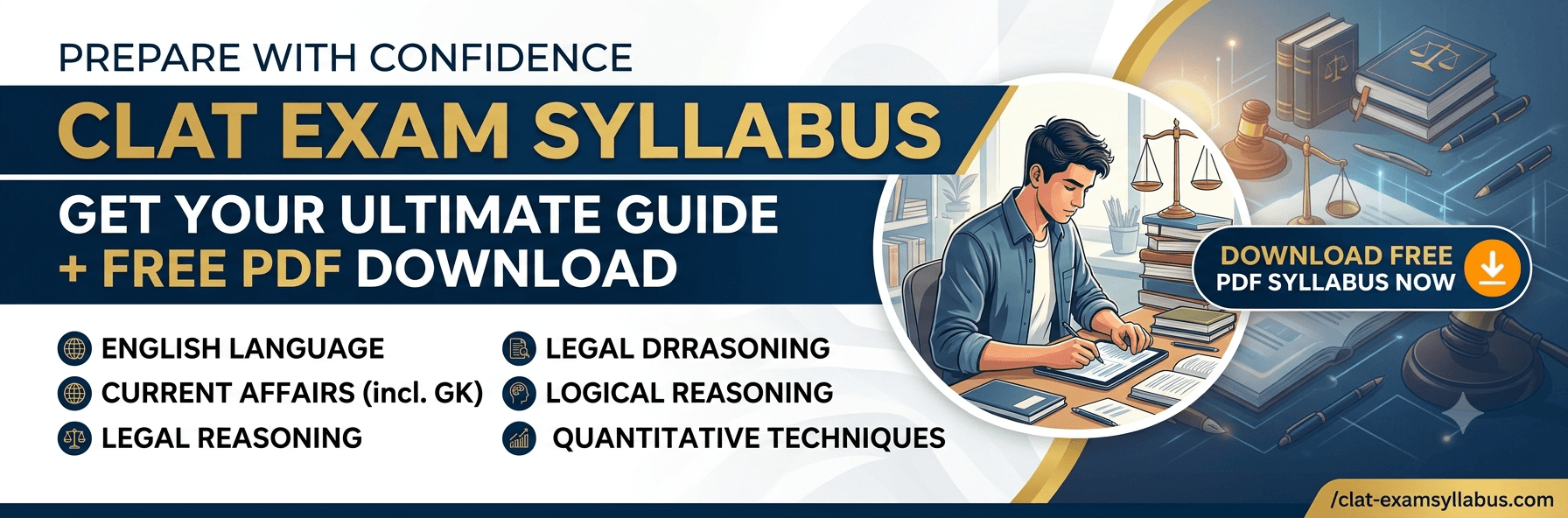
The syllabus of CLAT is something everybody aspiring to clear the exam in 2027 has to be familiar with. Knowledge regarding the exam pattern in addition to the skills required to perform well in each section of the examination becomes essential. The CLAT syllabus proves to be an important source of information for the students looking for admission to law schools as it informs them about the different sections included in the exam. There are five sections included in the CLAT UG paper: English Language, Current Affairs including General Knowledge, Legal Reasoning, Logical Reasoning and Quantitative Techniques. The CLAT PG exam covers subjects studied during the undergraduate law programme, so candidates should stay updated with the official website of the Consortium of National Law Universities.
Free Download
CLAT Exam Syllabus PDF 2027: Download UG & PG Syllabus, Exam Pattern and Preparation Guide
Share your details to get the free brochure delivered as a download.
Quick Overview of CLAT 2027
CLAT 2027 is the Common Law Admission Test conducted by the Consortium of National Law Universities. Candidates preparing for undergraduate and postgraduate law programmes should understand the examination format, duration, number of questions and marking scheme before starting their preparation.
| Particulars | Details |
|---|---|
| Full Form | Common Law Admission Test |
| Conducting Body | Consortium of National Law Universities |
| Exam Year | CLAT 2027 |
| UG Programme | Five-year integrated LL.B. programmes |
| PG Programme | LL.M. programmes |
| UG Subjects | Five sections |
| UG Exam Duration | 2 hours |
| UG Total Questions | 120 |
| Total Marks | 120 |
| Negative Marking | 0.25 marks for each incorrect answer |
| Official Website | consortiumofnlus.ac.in |
Download CLAT Exam Syllabus PDF 2027
Candidates should obtain the syllabus directly from the Consortium of NLUs to make sure they are using information applicable to the examination year. Follow these steps to access the CLAT syllabus:
1. Visit the official Consortium of NLUs website. 2. Go to the CLAT 2027 section. 3. Select the UG or PG syllabus according to the programme you wish to pursue. 4. Examine the syllabus details together with the corresponding official brochure or PDF document. 5. Save the document for offline reading.
The official website may display the syllabus as web content rather than as a separate downloadable document. If a PDF is not available, candidates can use the browser's Print option to save the page as a PDF. AdmissionDesk recommends checking all syllabus details against the official examination website instead of relying only on an old or unverified document.
CLAT UG Syllabus 2027: Subject-Wise Topics
The CLAT UG examination tests reading comprehension, logical thinking, awareness of current events and numerical skills. The syllabus is designed to assess abilities relevant to studying law rather than extensive prior knowledge of legal subjects.
1. English Language
The English Language section evaluates a candidate's ability to read and understand written material. It measures comprehension, interpretation, reasoning and the ability to identify different ideas and opinions. According to the syllabus, passages are expected to be approximately 450 words long, followed by questions assessing comprehension.
Important areas to prepare:
- Reading comprehension - Main idea and central theme - Author's tone, intention and viewpoint - Inference and conclusion - Summarising passages - Comparing arguments and viewpoints - Vocabulary in context - Meaning of words and phrases - Identifying supporting arguments
Preparation Tip: Read opinion pieces, essays and non-fiction regularly. After reading a text, identify its main point, supporting evidence and conclusion. Answer questions based on the passage rather than assumptions or outside information.
2. Current Affairs Including General Knowledge
This section evaluates awareness of important events in India and around the world. Questions may be based on news articles, journalism and other non-fiction material.
Important areas to prepare:
- National current affairs - International relations and global developments - Government policies and important initiatives - Important national and international organisations - Awards and honours - Major appointments - Arts and culture - Significant historical events - Important legal and constitutional developments - Major economic and social issues
Candidates should develop background knowledge of important events and understand why they matter rather than memorising isolated facts.
Preparation Tip: Maintain a current-affairs notebook containing important events, their significance, relevant facts and key people. Review these notes regularly and practise questions on current affairs.
3. Legal Reasoning
Legal Reasoning assesses a candidate's ability to understand principles, identify relevant facts and apply rules to specific situations. Candidates are not required to have extensive prior legal knowledge before taking the CLAT UG examination, although familiarity with legal and moral issues can be helpful.
Important areas to prepare:
- Identifying legal principles and rules - Applying principles to factual situations - Understanding legal arguments - Drawing conclusions from legal passages - Analysing changes in rules and their consequences - Contemporary legal issues - Public policy questions - Moral and philosophical questions - Identifying relevant facts in a legal scenario
Preparation Tip: Understand the principle or rule given in a passage first. Then examine the facts and apply the stated rule to reach an answer. Do not select an option simply because it sounds correct or matches your existing knowledge.
4. Logical Reasoning
Logical Reasoning evaluates analytical thinking and the ability to identify arguments, understand relationships and draw conclusions from written material. The section includes passages followed by questions that test reasoning and interpretation.
Important areas to prepare:
- Identifying premises and conclusions - Arguments and supporting evidence - Assumptions - Strengthening and weakening arguments - Inferences and deductions - Cause-and-effect reasoning - Analogies and relationships - Contradictions and equivalent statements - Evaluating the effectiveness of arguments - Identifying gaps in reasoning
Preparation Tip: Separate the author's main argument from the evidence used to support it. Identify unstated assumptions and determine whether the available evidence genuinely supports the conclusion.
5. Quantitative Techniques
Quantitative Techniques evaluates a candidate's ability to understand numerical information and apply mathematical concepts. Questions may include tables, data sets and other numerical representations. The required mathematical skills are broadly based on concepts taught up to Class 10.
Important areas to prepare:
- Ratios and proportions - Basic algebra - Mensuration - Statistical estimation - Arithmetic calculations - Interpretation of numerical information - Data-based problem-solving - Tables and other numerical representations
Preparation Tip: Revise fundamental mathematical concepts and practise interpreting data carefully. Focus on calculation accuracy, time management and understanding what a question asks before choosing the appropriate operation.
CLAT 2027 Exam Pattern and Section-Wise Weightage
Understanding the examination pattern helps candidates distribute their preparation time according to the approximate importance of each section. The CLAT UG format described here includes 120 multiple-choice questions, each carrying one mark, to be completed within two hours.
| Subject | Approximate Questions | Approximate Weightage |
|---|---|---|
| English Language | 22–26 | 20% |
| Current Affairs Including General Knowledge | 28–32 | 25% |
| Legal Reasoning | 28–32 | 25% |
| Logical Reasoning | 22–26 | 20% |
| Quantitative Techniques | 10–14 | 10% |
| Total | 120 | 100% |
CLAT 2027 Marking Scheme
The marking scheme determines how correct, incorrect and unattempted questions affect a candidate's score.
- Correct answer: +1 mark - Incorrect answer: -0.25 marks - Unattempted question: 0 marks - Total questions: 120 - Maximum marks: 120 - Examination duration: 120 minutes
Because incorrect answers attract negative marking, candidates should practise eliminating incorrect options and making informed decisions about which questions to attempt.
CLAT PG Syllabus 2027
Candidates preparing for CLAT PG should follow the syllabus applicable to postgraduate law admissions. The examination focuses on comprehension of legal materials and the application of knowledge gained during an undergraduate law degree. The following subjects provide a revision guide to important areas of legal study.
| Subject | Areas to Revise |
|---|---|
| Constitutional Law | Constitutional provisions, fundamental rights, constitutional principles and important judgments |
| Jurisprudence | Legal concepts, theories and principles of jurisprudence |
| Administrative Law | Administrative powers, principles and judicial review |
| Law of Contract | Contractual obligations, formation and legal remedies |
| Law of Torts | Civil wrongs and principles of liability |
| Family Law | Major legal principles governing family relationships |
| Criminal Law | Criminal-law principles and relevant statutory developments |
| Property Law | Ownership, transfer and related legal principles |
| Company Law | Corporate legal principles and statutory provisions |
| Public International Law | International legal principles and institutions |
| Tax Law | Core concepts and principles of taxation law |
| Environmental Law | Environmental legislation and legal principles |
| Labour and Industrial Law | Employment-related legislation and industrial relations |
CLAT UG vs CLAT PG Syllabus
CLAT UG and CLAT PG serve different admission purposes. The UG examination focuses on reading, reasoning, current affairs and numerical aptitude, while the PG examination evaluates legal comprehension and knowledge of law subjects.
| Particulars | CLAT UG | CLAT PG |
|---|---|---|
| Target Candidates | Students pursuing undergraduate law admission | Graduates pursuing postgraduate law admission |
| Main Focus | Reading, reasoning, current affairs and numerical aptitude | Legal comprehension and knowledge of law subjects |
| Sections | Five subject areas | One objective section |
| Question Format | Passage-based multiple-choice questions | Objective questions based on legal materials |
| Total Questions | 120 | 120 |
| Duration | 2 hours | 2 hours |
| Negative Marking | 0.25 per incorrect answer | 0.25 per incorrect answer |
How to Prepare for CLAT 2027 Using the Syllabus PDF
Downloading and reviewing the syllabus is an important first step in CLAT preparation. A structured strategy helps candidates set daily objectives, identify weaknesses and track their progress.
Step 1: Review the Syllabus
Carefully analyse the syllabus for your examination level. Identify the subjects, skills and question formats being tested. Use official examination information as your starting point and avoid relying exclusively on outdated or unverified topic lists.
Step 2: Assess Your Preparation
Attempt a previous-year question paper or an appropriate sample paper to understand your current level. Identify the sections in which you perform well and the topics that require additional practice.
Step 3: Create a Weekly Study Schedule
Allocate time to each of the five UG sections, giving additional attention to areas where your knowledge or accuracy is weak. A weekly plan can include:
- Reading comprehension and vocabulary practice - Regular current-affairs revision - Legal and logical reasoning exercises - Quantitative Techniques practice several times a week - Weekly mock tests and detailed analysis
PG candidates should organise their study schedule around the legal subjects specified in the applicable official syllabus.
Step 4: Practise Passage-Based Questions
The CLAT UG examination relies significantly on comprehension and reasoning. Practising passages can improve reading speed, interpretation and the ability to distinguish evidence-supported conclusions from assumptions. Review why each answer is correct or incorrect instead of focusing only on the final score.
Step 5: Revise Current Affairs Consistently
Maintain notes on major national and international events and review them regularly. Focus on understanding the background, context and significance of each event instead of memorising isolated facts.
Step 6: Analyse Mock Tests
After each mock test, review incorrect answers, skipped questions and questions that took too long. Maintain an error log to identify recurring mistakes, improve your approach and track progress over time.
Step 7: Recheck Official Updates
Before the examination, verify the latest syllabus, examination instructions and question-paper format on the official Consortium of NLUs website. Follow official notifications if any examination details change.
Common Mistakes to Avoid When Preparing for CLAT
Candidates can improve their preparation by avoiding these common mistakes:
1. Studying before checking the official syllabus: Older resources may not match the current examination requirements.
2. Ignoring reading comprehension: Reading quickly is not enough. Candidates must understand arguments, inferences and the author's intention.
3. Memorising legal concepts without applying them: CLAT UG Legal Reasoning requires candidates to understand principles and apply them to facts.
4. Ignoring Quantitative Techniques: Regular practice can improve accuracy and confidence in numerical questions.
5. Reading news without revision: Consistent revision helps candidates retain important events and their background.
6. Taking mock tests without analysing mistakes: Scores alone provide limited value unless candidates understand why they made errors.
7. Using outdated syllabus documents: Candidates should verify examination information against the latest official notification.
Frequently Asked Questions About CLAT Exam Syllabus PDF
Find answers to common questions about the CLAT 2027 syllabus, examination pattern, marking scheme and preparation strategy.
Where Can I Find the CLAT 2027 Syllabus in PDF Format?
Candidates should first check the official Consortium of NLUs website for the latest syllabus and examination documents. You can also refer to the AdmissionDesk guide at https://www.admissiondesk.info/blog/clat-exam-syllabus-2027-with-weightage. Verify the information against official updates.
What Are the Subjects Included in the CLAT UG Syllabus?
The five CLAT UG sections are English Language, Current Affairs including General Knowledge, Legal Reasoning, Logical Reasoning and Quantitative Techniques.
Is the CLAT UG Syllabus Different from the CLAT PG Syllabus?
Yes. CLAT UG focuses on reading comprehension, current affairs, legal reasoning, logical reasoning and quantitative skills. CLAT PG focuses on legal comprehension and subjects studied during an undergraduate law degree.
How Many Questions Are There in CLAT 2027?
The CLAT UG and PG examination formats described in this guide specify 120 multiple-choice questions for each examination, with a duration of two hours. Candidates should verify the relevant official examination instructions.
Is There Negative Marking in CLAT 2027?
Yes. The marking scheme described here deducts 0.25 marks for each incorrect answer. An unattempted question carries no marks.
Is Legal Knowledge Required for CLAT UG?
Extensive prior legal knowledge is not required for the CLAT UG Legal Reasoning section. The examination primarily evaluates a candidate's ability to understand principles and apply them to given facts. Familiarity with legal and moral issues can be beneficial.
What Mathematics Topics Are Included in CLAT UG?
The Quantitative Techniques section covers mathematical skills broadly aligned with the Class 10 level, including ratios and proportions, basic algebra, mensuration, statistical estimation and numerical data interpretation.
How Should I Prepare for CLAT Using the Syllabus PDF?
Begin by reviewing the syllabus, assessing your strengths and weaknesses and creating a weekly study plan. Practise comprehension and reasoning questions, revise current affairs, work on numerical problems and analyse mock-test performance regularly.
Is the CLAT Syllabus the Same Every Year?
Candidates should not assume that the syllabus or examination pattern will remain unchanged indefinitely. Always consult the notification and syllabus for the examination year in which you intend to appear.
Which Website Should I Trust for the CLAT Syllabus?
The official Consortium of National Law Universities website is the primary source for the CLAT syllabus, examination pattern and official instructions. Other educational websites can provide preparation guidance, but their information should be cross-checked against official updates.
Final Thought
The CLAT Exam Syllabus PDF 2027 provides candidates with a starting point for planning their preparation for the law entrance examination. Understanding the syllabus, examination structure and marking scheme can help students decide what to study and organise their preparation more effectively. Undergraduate aspirants should focus on reading comprehension, current affairs, legal reasoning, logical reasoning and quantitative techniques. Postgraduate aspirants should revise the legal subjects included in the applicable official syllabus and improve their ability to understand legal texts and apply legal knowledge. For accurate information, visit the official Consortium of NLUs website and check the latest examination updates before preparing or applying. AdmissionDesk Tip: Keep the syllabus saved for offline access, create a realistic weekly study plan, practise questions regularly and evaluate your progress through mock tests. Consistent practice, careful reasoning and regular revision can make CLAT preparation more structured and manageable.