
CLAT Exam Pattern 2027: UG & PG Paper Pattern, Marking Scheme, Section-Wise Weightage
Check the CLAT Exam Pattern 2027 for UG and PG, including the paper structure, total questions, marks, exam duration, section-wise weightage, negative marking and preparation tips.
By Admission Desk
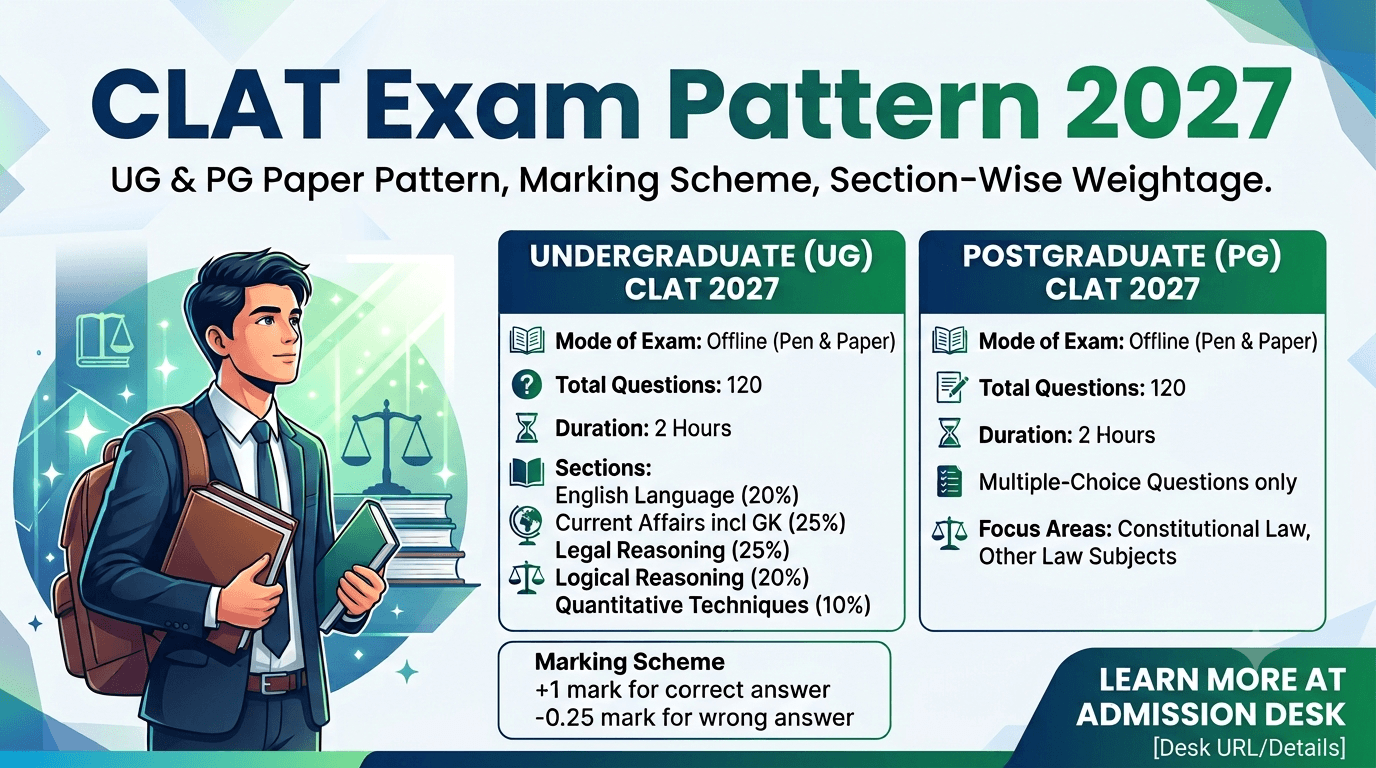
The CLAT Exam Pattern 2027 helps candidates understand the number of questions, total marks, examination duration, section-wise weightage, and negative marking for the Common Law Admission Test. Conducted by the Consortium of National Law Universities (NLUs), CLAT is a national-level entrance examination for admission to undergraduate and postgraduate law programmes at participating National Law Universities. For CLAT 2027, the examination pattern remains unchanged for both UG and PG courses, according to the Consortium's announcement. The exam is scheduled for 6 December 2026. Candidates preparing for the examination should understand the paper structure and marking scheme before finalising their preparation strategy. This guide explains the CLAT 2027 exam pattern, including the UG and PG question paper formats, subject-wise distribution, marking scheme, and preparation tips. Candidates should check the official Consortium of NLUs website for the latest examination instructions.
Free Download
CLAT Exam Pattern 2027: UG & PG Paper Pattern, Marking Scheme, Section-Wise Weightage
Share your details to get the free brochure delivered as a download.
CLAT Exam Pattern 2027: Highlights
The CLAT 2027 examination pattern provides an overview of the paper structure, duration, marking scheme and question format for both undergraduate and postgraduate law programmes. The following table summarises the major examination details.
Important Difference Between CLAT UG and PG
The UG and PG examinations share the same basic structure in terms of duration, total marks, number of questions and negative marking. However, their syllabuses and question content differ according to the programme. CLAT UG assesses reading comprehension, current affairs, legal reasoning, logical reasoning and quantitative techniques, whereas CLAT PG focuses on comprehension and application of undergraduate-level legal knowledge.
| Particulars | CLAT UG 2027 | CLAT PG 2027 |
|---|---|---|
| Exam name | Common Law Admission Test | Common Law Admission Test |
| Conducting body | Consortium of NLUs | Consortium of NLUs |
| Purpose | 5-year integrated LL.B. programmes | 1-year LL.M. programmes |
| Exam date | 6 December 2026 | 6 December 2026 |
| Exam mode | Offline | Offline |
| Duration | 2 hours | 2 hours |
| Total questions | 120 | 120 |
| Question type | Multiple-choice questions (MCQs) | Multiple-choice questions (MCQs) |
| Total marks | 120 | 120 |
| Marks for each correct answer | +1 | +1 |
| Negative marking | -0.25 | -0.25 |
| Unanswered questions | No penalty | No penalty |
CLAT UG Exam Pattern 2027
The CLAT UG examination is designed for candidates seeking admission to five-year integrated law programmes, such as BA LL.B., BBA LL.B., B.Com. LL.B. and other eligible integrated law degrees offered by participating institutions. According to the stated CLAT 2027 question paper format, the UG examination contains 120 multiple-choice questions carrying 120 marks, to be completed within two hours.
CLAT UG 2027 Section-Wise Weightage
The CLAT UG question paper consists of five sections. The question counts shown below are approximate ranges, and the actual distribution may vary between question papers.
| Subject | Approximate Questions | Approximate Weightage |
|---|---|---|
| English Language | 22–26 | 20% |
| Current Affairs, including General Knowledge | 28–32 | 25% |
| Legal Reasoning | 28–32 | 25% |
| Logical Reasoning | 22–26 | 20% |
| Quantitative Techniques | 10–14 | 10% |
| Total | 120 | 100% |
CLAT UG 2027 Section-Wise Syllabus and Preparation Tips
Understanding what each section tests can help candidates choose suitable study material and improve their preparation strategy.
1. English Language
The English Language section evaluates reading comprehension, vocabulary in context and the ability to understand arguments and viewpoints. Candidates can expect passages of approximately 450 words, followed by questions related to identifying the main idea and central argument, drawing inferences and conclusions, understanding words and phrases in context, summarising passages, and comparing different viewpoints and arguments. Preparation tip: Read editorials, opinion articles and quality non-fiction regularly. Practise answering passage-based questions within a time limit.
2. Current Affairs, Including General Knowledge
This section assesses awareness of significant national and international events. Questions are passage-based and may cover contemporary developments as well as historical events of continuing significance. Important areas include national and international current affairs, government policies and major decisions, international relations, awards, important appointments, significant events, art and culture, relevant historical developments, and legal or public-policy developments discussed in the news. Preparation tip: Maintain monthly current-affairs notes and revise important events regularly. Focus on understanding the context behind news stories rather than memorising isolated facts.
3. Legal Reasoning
Legal Reasoning tests a candidate's ability to understand legal principles and apply them to factual situations. Prior formal legal education is not required to attempt this section. Questions may involve identifying legal rules and principles, applying principles to hypothetical situations, understanding legal and public-policy issues, analysing how a change in a rule affects its application, and drawing conclusions from the information provided. Preparation tip: Practise passage-based legal reasoning questions and concentrate on applying the given principle accurately. Avoid relying on assumptions that are not supported by the passage.
4. Logical Reasoning
The Logical Reasoning section evaluates critical thinking and the ability to analyse arguments. Candidates must identify relationships between statements and determine whether conclusions follow from the available evidence. Topics and skills include identifying premises and conclusions, strengthening and weakening arguments, drawing logical inferences, recognising assumptions, understanding contradictions and analogies, and evaluating the effectiveness of arguments. Preparation tip: Solve analytical reasoning and critical reasoning questions daily. Review incorrect answers to understand the reasoning error rather than simply memorising the correct option.
5. Quantitative Techniques
Quantitative Techniques tests basic mathematical skills and the ability to interpret numerical information presented through short sets of facts, tables or other representations. Questions may involve ratios and proportions, percentages, basic algebra, mensuration, statistical estimation, data interpretation and numerical calculations. The mathematical operations are generally based on concepts taught up to Class 10. Preparation tip: Revise basic mathematical formulas and practise data interpretation. Accuracy is particularly important because incorrect answers attract negative marks.
CLAT PG Exam Pattern 2027
The CLAT PG examination is intended for candidates seeking admission to one-year LL.M. programmes at participating institutions. Unlike the UG paper, the PG examination focuses on comprehension and application of legal knowledge. The stated CLAT PG 2027 question paper format includes 120 objective-type questions carrying one mark each, with a total duration of 120 minutes.
| Particulars | Details |
|---|---|
| Total questions | 120 |
| Total marks | 120 |
| Exam duration | 120 minutes |
| Question type | Multiple-choice questions |
| Exam mode | Offline |
| Correct answer | +1 mark |
| Incorrect answer | -0.25 mark |
| Unanswered question | 0 marks |
CLAT PG 2027 Syllabus and Important Legal Subjects
The CLAT PG paper is based on undergraduate-level law subjects. Candidates should revise core LL.B. topics and practise passages drawn from legal materials, judgments and statutory provisions. The following table lists important subject areas and the concepts candidates may need to review.
How to Prepare for the CLAT PG Paper
The PG examination uses extracts from primary legal materials, including important court decisions, statutes and regulations. Candidates must demonstrate comprehension, awareness of legal issues and the ability to apply their legal knowledge. Revise core LL.B. subjects, study important judgments and practise questions based on legal passages. Focus on understanding the legal issue and the reasoning behind a decision instead of memorising legal provisions in isolation.
| Subject Area | Topics Covered |
|---|---|
| Constitutional Law | Constitutional provisions, fundamental rights, constitutional principles and important judgments |
| Jurisprudence | Legal philosophy, theories of law and jurisprudential concepts |
| Administrative Law | Administrative powers, principles of natural justice and judicial review |
| Law of Contract | Contract formation, contractual obligations and remedies |
| Law of Torts | Civil wrongs and legal liability |
| Family Law | Important principles of family law |
| Criminal Law | Relevant criminal law principles and legal developments |
| Property Law | Transfer of property and related legal principles |
| Company Law | Corporate legal principles and company regulation |
| Public International Law | International legal rules and institutions |
| Tax Law | Fundamental principles of taxation law |
| Environmental Law | Environmental regulation and legal protection |
| Labour and Industrial Law | Employment-related laws and industrial relations |
CLAT Marking Scheme 2027
Understanding the CLAT marking scheme is essential for improving accuracy and maximising the final score. Each correct answer earns one mark, while an incorrect answer results in a deduction of one-fourth of a mark. There is no penalty for leaving a question unanswered.
How to Calculate Your CLAT Score
Candidates can calculate their approximate score using the following formula: CLAT Score = Correct Answers − (Incorrect Answers × 0.25). For example, suppose a candidate attempts 100 questions, with 80 correct answers and 20 incorrect answers. Correct answers: 80 × 1 = 80 marks. Incorrect answers: 20 × 0.25 = 5 marks deducted. Unanswered questions: 20 × 0 = 0 marks deducted. Final score = 80 − 5 = 75 marks out of 120. This calculation can help candidates evaluate their performance in mock tests and identify areas where accuracy needs improvement.
| Response Type | Marks Awarded |
|---|---|
| Correct answer | +1 |
| Incorrect answer | -0.25 |
| Unanswered question | 0 |
CLAT Exam Pattern 2027: Time Management Strategy
Candidates have 120 minutes to answer 120 questions. This gives an average of one minute per question, although some passages and question sets may require more time than others. A practical time-management strategy can help candidates complete the paper without sacrificing accuracy.
- Start with a familiar section where you can read and answer accurately without spending too much time.
- Set passage-level time limits and monitor the time spent reading each passage and answering its questions.
- Avoid getting stuck on difficult questions. Move ahead and return to them if time permits.
- Practise OMR-based mock tests because the examination is conducted offline.
- Keep a few minutes for review, unanswered questions and checking that responses are marked correctly.
- Choose your section order according to your strengths and test different approaches during mock examinations.
How to Prepare According to the CLAT Exam Pattern 2027
A preparation plan based on the examination structure can help candidates distribute their time effectively and focus on areas that need improvement.
1. Understand the Syllabus and Question Format
Read the official UG or PG syllabus carefully. Understand the nature of passage-based questions and identify the subjects that require additional practice. Use the latest official examination information as the basis for your preparation plan.
2. Read Daily for Comprehension
Regular reading improves speed, vocabulary and the ability to identify arguments. Include editorials, long-form articles and relevant news reports in your daily routine. Practise summarising passages and identifying their central arguments.
3. Practise Section-Wise Questions
Solve questions from all five UG sections or the relevant PG legal subjects. Track your accuracy and the time required for each question set. Review incorrect responses to identify recurring weaknesses.
4. Take Full-Length Mock Tests
Attempt full-length mock tests under examination-like conditions. Since the examination lasts two hours, practising within the same duration helps develop stamina, concentration and time-management skills.
5. Analyse Every Mock Test
After each test, categorise mistakes into conceptual errors, misreading, poor time management and incorrect guesses. Use the analysis to plan the next revision cycle. Focus on reducing repeated mistakes rather than simply increasing the number of mock tests attempted.
6. Use Previous-Year Question Papers
Previous-year papers help candidates understand the style of questions and the level of comprehension required. Use them alongside the latest official syllabus rather than assuming that every previous paper reflects the current format exactly.
7. Revise Consistently
Create short revision notes for current affairs, important legal developments, mathematical formulas and frequently misunderstood reasoning concepts. Regular revision is more effective than leaving all revision until the final days.
CLAT Exam Pattern 2027: Important Points to Remember
Candidates should keep the following examination details in mind while preparing for CLAT 2027.
- CLAT 2027 is scheduled for 6 December 2026.
- Both UG and PG examinations have 120 questions and 120 marks under the stated pattern.
- The examination duration is two hours.
- Each correct answer earns one mark.
- Each incorrect answer results in a deduction of 0.25 marks.
- Unanswered questions do not attract negative marking.
- The UG paper contains five sections.
- The PG paper focuses on undergraduate-level legal subjects and comprehension.
- The examination is scheduled to be conducted offline.
- Candidates should check the official Consortium website for subsequent instructions or updates.
Frequently Asked Questions
1. What is the exam pattern of CLAT 2027?
Under the stated pattern, CLAT 2027 consists of 120 multiple-choice questions for 120 marks, with a duration of two hours. Each correct answer earns one mark, while each incorrect answer attracts a penalty of 0.25 marks. The same basic structure applies to both UG and PG examinations.
2. How many questions are there in CLAT UG 2027?
CLAT UG 2027 has 120 questions divided across English Language, Current Affairs including General Knowledge, Legal Reasoning, Logical Reasoning and Quantitative Techniques.
3. Is there negative marking in CLAT 2027?
Yes. Candidates lose 0.25 marks for each incorrect answer. No marks are deducted for unanswered questions.
4. What is the duration of the CLAT examination?
The standard examination duration is 120 minutes, or two hours. Eligible candidates receiving approved examination accommodations should check the official instructions applicable to their category.
5. What is the section-wise weightage of CLAT UG 2027?
English Language and Logical Reasoning each account for approximately 20% of the paper. Current Affairs including General Knowledge and Legal Reasoning each account for approximately 25%, while Quantitative Techniques accounts for approximately 10%. The actual number of questions may vary.
6. Is the CLAT 2027 exam pattern different for UG and PG?
The basic structure is the same: 120 questions, 120 marks, two hours and 0.25 negative marking for an incorrect answer under the stated pattern. The subjects and question content differ between the UG and PG examinations.
7. Is CLAT conducted online or offline?
CLAT 2027 is scheduled to be conducted in offline mode. Candidates should follow the official examination instructions for the prescribed response sheet and other examination procedures.
8. How can I score well in CLAT 2027?
Build a strong reading habit, practise section-wise questions, revise current affairs, solve mock tests, analyse mistakes and improve accuracy. Familiarity with the marking scheme can also help you avoid unnecessary negative marks.
Final Verdict: CLAT Exam Pattern 2027
The CLAT Exam Pattern 2027 provides a framework for preparing for both undergraduate and postgraduate law entrance examinations. With 120 questions, 120 marks and a two-hour duration under the stated pattern, the examination requires a combination of reading comprehension, reasoning, subject knowledge, accuracy and time management. UG candidates should prepare systematically across all five sections, while PG candidates should focus on core legal subjects and passage-based legal analysis. Regular mock tests, consistent revision and careful evaluation of mistakes can help candidates develop a more effective preparation strategy. For the latest examination instructions and confirmation of the applicable paper format, candidates should refer to the official Consortium of NLUs website.
Final Thought
The CLAT Exam Pattern 2027 explains the question paper structure, examination duration, section-wise weightage and marking scheme for UG and PG law entrance examinations. Under the stated format, candidates answer 120 questions in two hours, receive one mark for each correct answer and lose 0.25 marks for each incorrect response. UG candidates should practise all five sections, while PG candidates should revise core legal subjects and develop strong passage-comprehension skills. Use mock tests, timed practice and regular revision to improve accuracy and time management. Check the official Consortium of NLUs website for the confirmed examination pattern, latest instructions and any subsequent updates.