
XAT 2027 Syllabus: Section-Wise Topics, Exam Pattern & Preparation Tips
Explore the XAT 2027 syllabus with section-wise topics for Verbal Ability and Logical Reasoning, Decision Making, Quantitative Ability and Data Interpretation, and General Knowledge, along with the exam pattern, marking scheme, important dates and preparation tips.
By Admission Desk
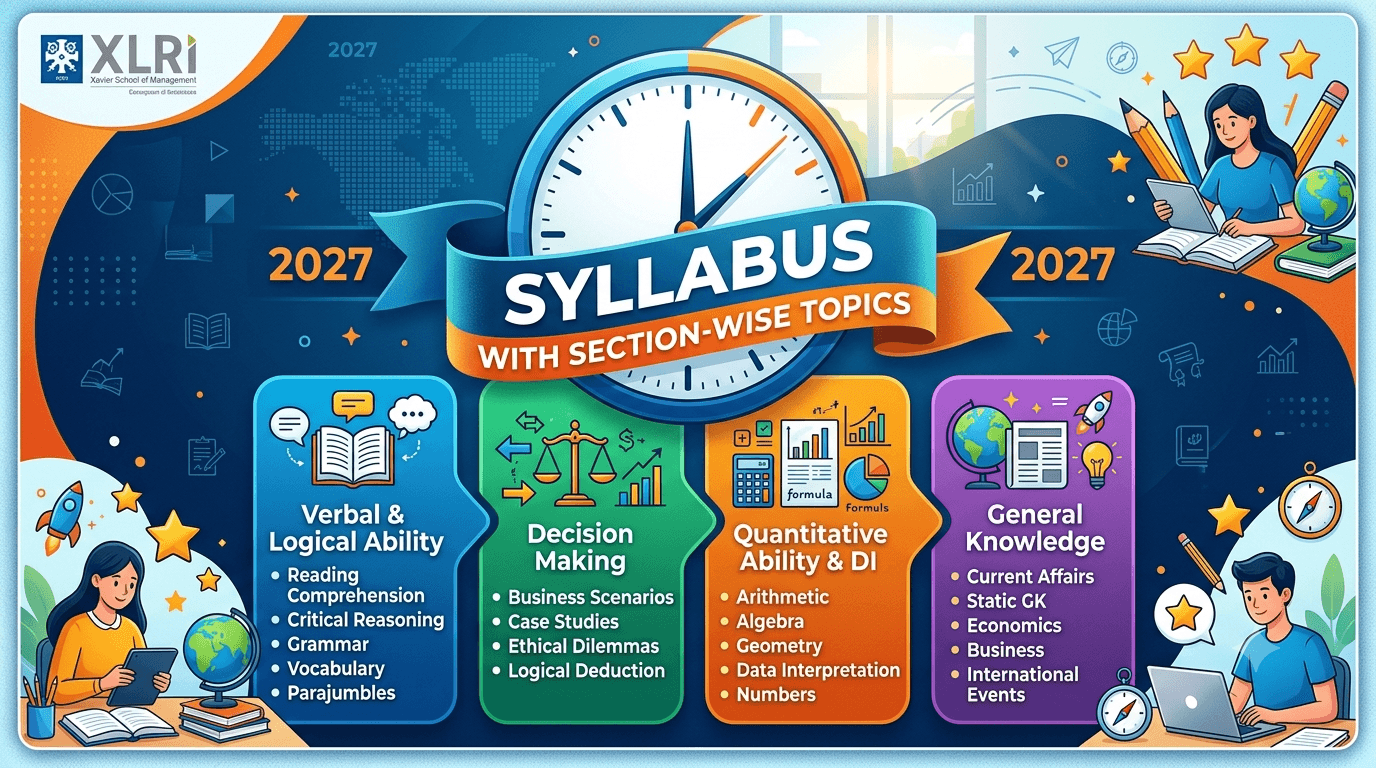
Students desiring to undertake the Xavier Aptitude Test employ the XAT 2027 syllabus. This is one of the country's competitive examinations that provide aspiring candidates admission into preferred management schools and help in establishing their careers in the domain. The test is being held by the organization XLRI Jamshedpur. The syllabus checks the candidates aptitude of various subjects such as mathematical skills, verbal skills, logical reasoning, decision-making and more. If you're considering pursuing your MBA from XLRI or any other reputed management institute, familiarizing yourself with the XAT 2027 syllabus can assist in subject choices and the way you choose to study. It will allow you to pay more attention to important areas thus raising your chances of clearing your exam. This blog written by the admission desk seo team will provide you useful information regarding the subject.
Free Download
XAT 2027 Syllabus: Section-Wise Topics, Exam Pattern & Preparation Tips
Share your details to get the free brochure delivered as a download.
XAT 2027 Exam Overview
The official XAT site reports that the exam commencement date is January 3, 2027. Candidates are advised to keep visiting the site for the announcement and updates on the test.
| **Particulars** | **Details** |
|---|---|
| Exam Name | Xavier Aptitude Test (XAT) 2027 |
| Conducting Body | XLRI Jamshedpur |
| Exam Level | National-level entrance examination |
| Exam Mode | Computer-Based Test (CBT) |
| Exam Date | 3 January 2027 |
| Exam Timing | 2:00 PM to 5:00 PM |
| Duration | 180 minutes |
| Total Questions | Approximately 95, as per the published exam pattern |
| Main Sections | Verbal Ability & Logical Reasoning, Decision Making, Quantitative Ability & Data Interpretation, General Knowledge |
| Courses Offered | MBA, PGDM and other management programmes |
| Official Website | [https://xatonline.in/](https://xatonline.in/) |
XAT 2027 Syllabus: Section-Wise Topics
The XAT syllabus includes four sections. The purpose of these sections is to evaluate candidates’ knowledge in areas important to management studies and decision-making processes.
**1. Verbal and Logical Reasoning (VALR)**
This section tests the candidate’s ability to comprehend English language and evaluate his/her capability of logical thinking.
It is highly important to understand the passage as it might present various viewpoints, cover social issues, issues of economics, political issues, and current business affairs.
**Important topics in XAT Verbal Ability and Logical Reasoning:**
Advice for Preparation: The advice is to read every day. This includes reading newspapers, magazines, and editorial articles daily, which will improve reading speed and vocabulary and help one learn the different purposes of writing.
### 2. Decision Making (DM)
### Decision Making is a unique area in XAT, and it is distinct from both the math and verbal areas in that it does not use any mathematics or grammar exercises but, instead, gives candidates realistic cases and ethical situations to examine in order to solve them.
### In DM, candidates will face literary problems where they will be required to read the case, find key elements of it, evaluate options, and make decisions.
**Important topics in XAT Decision Making:**
We should note about the importance of getting truly familiar with the XAT Decision Making papers as well as being aware what exactly is wrong with other answer options besides the right choice. Think in terms of being fair, reasonable, truth-seeking and doing good for all.** **
**3. Quantitative Ability and Data Interpretation **
\
Quantitative Ability (QA) and Data Interpretation (DI) evaluate a candidate's capability in mathematical calculations, numbers' application for logical reasoning, analytical and problem-solving abilities.
While the Quantitative Ability part assesses a candidate's skill in using concepts, the Function of Data Interpretation assesses a candidate's capability of obtaining specific information from the given tables, graphs, or charts.**  **
**Important topics in XAT Quantitative Ability:**
**Important topics in Data Interpretation:**
Preparation suggestions: Initially practice solving basic and advanced arithmetic and algebra problems. It is also advisable to keep all important formulas noted in a notebook. Moreover, make sure to try as many time-bound assignments as possible to learn what questions require more time or effort.
**4. General Knowledge (GK)**
This section evaluates the understanding of static and current affairs. It can concentrate on local news or international occurrences, economics, trade, politics, science and technical progress, sporting activities, culture as well as other noteworthy happenings.
Aspects to bear in mind about GK in XAT.
**Important topics in XAT General Knowledge:**
Hints for preparation: Stick to reputed newspapers regularly, make short notes on crucial things and revise current events of the last 6–12 months. The exact distribution of topics can change each year.
Applicants are informed that the GK part has historically been regarded differently compared to other components of XLRI's selection process. Consult the latest official guidelines for the scoring and evaluation criteria.
| **Topic** | **What to Prepare** | | ------------------------ | ------------------------------------------------------------------- | | Business Decision Making | Selecting suitable solutions to business problems | | Ethical Dilemmas | Evaluating fairness, integrity and ethical responsibilities | | Managerial Issues | Handling workplace and organisational situations | | Situational Judgement | Analysing real-life scenarios and possible responses | | Analytical Reasoning | Evaluating information and drawing logical conclusions | | Data Arrangements | Organising information to solve a problem | | Caselets | Understanding short case studies and identifying solutions | | Financial Decisions | Evaluating financial constraints and competing interests | | Grouping and Conditions | Applying conditions and logical relationships | | Stakeholder Analysis | Considering the interests of employees, customers and organisations |
| **Topic** | **Important Subtopics** | | ------------------------------ | ---------------------------------------------------------- | | Arithmetic | Percentages, ratios, proportions and averages | | Profit and Loss | Cost price, selling price, discounts and profit percentage | | Time, Speed and Distance | Relative speed, trains, boats and streams | | Time and Work | Work efficiency, combined work and pipes and cisterns | | Simple and Compound Interest | Interest calculations and financial applications | | Algebra | Equations, expressions, identities and inequalities | | Linear and Quadratic Equations | Equation solving and roots | | Geometry | Triangles, circles, polygons and coordinate geometry | | Mensuration | Area, perimeter, surface area and volume | | Number System | Divisibility, factors, multiples and remainders | | Functions | Domain, range and function-based problems | | Probability | Basic probability and event-based calculations | | Permutation and Combination | Counting principles and arrangements | | Set Theory | Venn diagrams and set-based problems | | Trigonometry | Ratios, identities and heights and distances |
| **Topic** | **Important Areas** | | --------------------------- | ------------------------------------------------------ | | Current Affairs | Major national and international events | | Business and Economy | Economic developments, banking and financial news | | Corporate Affairs | Major companies, mergers and acquisitions | | Indian Polity | Constitution, governance and important institutions | | History | Indian history and significant historical events | | Geography | Countries, capitals, physical and political geography | | Science and Technology | Scientific developments and technological advancements | | Awards and Honours | Important national and international awards | | Sports | Tournaments, achievements and sporting personalities | | Books and Authors | Notable books and their authors | | International Organisations | Important global organisations and their functions | | Government Schemes | Major government initiatives and policies |
- Tables and tabular data
- Bar graphs and line graphs
- Pie charts
- Caselet-based data interpretation
- Data comparison and percentage calculations
- Ratios, averages and weighted averages
- Mixed graphs and charts
- Sufficiency of data and formative analysis, wherever fit
| **Topic** | **What to Prepare** |
|---|---|
| Reading Comprehension | Main idea, inference, tone, author's perspective and passage-based questions |
| Vocabulary | Word meanings, synonyms, antonyms and contextual usage |
| Grammar | Parts of speech, sentence correction and grammatical rules |
| Para Jumbles | Arranging sentences in a logical sequence |
| Fill in the Blanks | Vocabulary and sentence completion |
| Critical Reasoning | Arguments, assumptions, conclusions and inferences |
| Logical Completion of Ideas | Identifying the most appropriate continuation of an argument |
| Analogies | Understanding relationships between words and concepts |
| Sentence Correction | Identifying grammatical and structural errors |
| Para Completion | Selecting the sentence that best completes a paragraph |
XAT 2027 Exam Pattern
Understanding the exam pattern alongside the XAT 2027 syllabus helps candidates plan their preparation and allocate time effectively.
The following table presents the commonly published XAT pattern. Candidates should verify the final question count and instructions against the official XAT 2027 information.
### Important Features of the XAT Exam Pattern
- **Computer-based examination:** Candidates take the test online at an allotted examination centre.
- **Combined time for Part 1:** The three main aptitude sections share the allotted time rather than having separate sectional timers under the commonly published pattern.
- General Knowledge: GK is evaluated in a separate section in Part 2.
- Choice of questions: Participants need to make sure that they balance the accuracy, complexity of the topic as well as time involved in responding.
- Nowadays, analytical essay writing is also included in the Group Discussion and Personal Interview stage of the recruitment process. Applicants need to check the latest official notifications regarding the admissions process.
| **Section** | **Approximate Number of Questions** | **Time Allocation** |
|---|---|---|
| Verbal Ability and Logical Reasoning | 26 | Part 1: 170 minutes combined |
| Decision Making | 21 | Part 1: 170 minutes combined |
| Quantitative Ability and Data Interpretation | 28 | Part 1: 170 minutes combined |
| General Knowledge | 20 | Part 2: 10 minutes |
| Total | 95 | 180 minutes |
XAT 2027 Marking Scheme
Marking scheme plays an important role in preparation since it assists in selecting questions and accuracy of the effort put in.
Under the commonly published XAT marking pattern:
In the past, unattempted questions attracted a penalty of 0.10 in each case, after a certain threshold was crossed in Part 1. The exact limit and special cases can be checked in the XAT 2027 guidelines before the test.
| **Response Type** | **Marking Rule** |
|---|---|
| Correct Answer | +1 mark |
| Incorrect Answer | -0.25 mark |
| Unattempted Questions | Penalty may apply after the permitted number of unattempted questions |
| General Knowledge | Evaluated separately under the applicable XAT rules |
Important Topics in XAT 2027 Syllabus
Even though all areas of the syllabus need to be addressed, candidates should focus primarily on specific areas while starting their preparation.
It is essential that a priority list of preparation items is developed but it should also be remembered that it is not an assurance of how many questions on any topic will make their way to the exam.
| **Section** | **High-Priority Topics** |
|---|---|
| Verbal Ability and Logical Reasoning | Reading Comprehension, Critical Reasoning, Grammar and Para Jumbles |
| Decision Making | Caselets, Ethical Dilemmas, Managerial Decisions and Situational Judgement |
| Quantitative Ability | Arithmetic, Algebra, Geometry, Number System and Modern Mathematics |
| Data Interpretation | Tables, Graphs, Pie Charts and Caselet-Based Sets |
| General Knowledge | Current Affairs, Business, Economy, Awards and International Events |
How Can One Prepare for XAT 2027
One of the effective ways to manage your study timetable is to have a plan whereby one will effectively learn the entire syllabus if he is keeping in mind the important skills of correctness, quickness and intelligence.
**1. Acknowledge All Parts of the Curriculum**
Start your preparation by familiarizing yourself with every area of the XAT curriculum to assess your strengths and weaknesses.
**2. Strengthen Your Quantitative Foundation Prior to Getting into the Tough One**
Ensure that you learn the basic ideas of algebra, geometry and arithmetic before you try to work on complex tasks. Once you complete several tasks of different difficulty levels, it is important to check your errors.
**3. Always Work on your Decision Making Skills**
When reviewing your efforts at solving problems in the Decision Making exams’ past papers, it is important to ascertain how you arrived at your conclusions and determine potential areas of improvement for your answers.
**4. Boost Your Reading Comprehension**
Make it a habit to read opinion articles, business magazines and analytical texts every day. Work on identifying main idea occurrences, author’s tone, assumptions, conclusions and implicit messages.
**5. Stay Current with General Knowledge**
Stay in the loop with all relevant news and events at the local and global levels, innovations and changes in the field of economy, political choices of the governments and sports events. Review your notes regularly instead of postponing it for the last few days before the exam.
**6. Practice Past-Year Papers**
Solving the question papers of XAT from previous years helps in understanding the type of questions, difficulty level, and thinking involved in the XAT examination. Also, try to attempt as many questions as possible within the time constraints given.
**7. Give Mock Tests and Evaluate Performance**
Start with section-wise tests and subsequently move to full paper end mock tests. After each test, analyze the mistakes to check whether they were due to incorrect understanding, wrong interpretation, errors in calculation, or time management issues.
**8. Form a Time-Management Plan **
Inasmuch as the different aptitude sections use the same total time as well as the common pattern of distribution, it is important to be able to make decisions about when to skip to the next question.
XAT 2027 Preparation Plan
Candidates can adapt the following schedule according to their current preparation level and the time remaining before the examination.
Students with weaker basic skills might require longer duration in foundation stage, whereas those students who have studied for CAT or other management entrance exam can start with diagnostic evaluation tests and tailored preparation.
| **Preparation Phase** | **Main Focus** |
|---|---|
| Phase 1: Foundation | Complete basic concepts in Quantitative Ability, Verbal Ability and Logical Reasoning |
| Phase 2: Sectional Practice | Solve Decision Making caselets, Data Interpretation sets and comprehension passages |
| Phase 3: Advanced Practice | Attempt difficult questions and previous-year papers |
| Phase 4: Mock Tests | Take timed mock tests and analyse mistakes |
| Final Revision | Modify equations, GK notes, main ideas and method of taking tests |
XAT 2027 key Dates
As per the official XAT website, the important dates that have been provided for XAT 2027 are:
The dates may change depending on any new notifications issued by the examination authority and students are required to check the official website for confirmation of their schedule.
| **Event** | **Date** |
|---|---|
| Registration Begins | 15 July 2026 |
| Registration Closes | 6 December 2026 |
| Admit Card Release | 20 December 2026, tentative |
| XAT 2027 Examination | 3 January 2027, 2:00 PM to 5:00 PM |
XAT 2027 Eligibility Criteria
Candidates interested in appearing for XAT 2027 must check the eligibility clauses applicable for specific management programmes.
Generally, one of the eligibility conditions of the relevant management programmes of XLRI is having a degree of three years of minimum duration and recognized by the authority along with other equivalent qualifications. Final-year students may also be eligible if they fulfill the requirements.
Every individual institution and program may set their own eligibility requirements. Check with the official admission guidelines before application.
Colleges Accepting XAT Scores
The official website of XAT states that more than 250 management institutions in India accept XAT scores. The institutes may have their own cut-off and selection criteria.
Some well-known institutes accepting XAT scores include:
AThe acceptance of XAT scores does not mean that the student will automatically qualify for admission. The candidate must check the eligibility, cut-offs, fee, and selection process of each particular program in the institution.
- XLRI Jamshedpur
- XIM University, Bhubaneswar
- IMI New Delhi
- Goa Institute of Management
- Institute of Management Technology, Ghaziabad
- TAPMI, Manipal
- MICA, Ahmedabad
- K J Somaiya Institute of Management, Mumbai
- Great Lakes Institute of Management
Frequently Asked Questions About XAT 2027 Syllabus
**1. What is the XAT 2027 syllabus?**
The XAT 2027 syllabus covers Verbal Ability and Logical Reasoning, Decision Making, Quantitative Ability and Data Interpretation and General Knowledge.
**2. How many sections are there in XAT 2027?**
The published XAT pattern has four sections: Verbal Ability and Logical Reasoning, Decision Making, Quantitative Ability and Data Interpretation and General Knowledge.
**3. Is Decision Making compulsory in XAT?**
Decision Making is a component of the XAT examination and is important for candidates targeting XLRI and other institutes that use XAT scores.
**4. Is the XAT syllabus similar to the CAT syllabus?**
There is overlap in Verbal Ability, Logical Reasoning, Quantitative Ability and Data Interpretation. However XAT has a Decision Making section and a General Knowledge section so candidates should prepare for these separately.
**5. Which topics are most important in XAT Quantitative Ability?**
Arithmetic, algebra, geometry, number systems, percentages, ratios, averages and data interpretation are priorities for preparation. The actual topic distribution may change each year.
**6. How should I prepare for XAT Decision Making?**
Practise previous-year caselets, analyse managerial situations consider stakeholder interests and choose solutions supported by the facts presented in each question.
**7. How many months are required to prepare for XAT 2027?**
Preparation time depends on your aptitude and familiarity with the syllabus. A plan covering concept revision, regular practice, previous-year papers and mock-test analysis is generally more useful than relying on a fixed number of months.
**8. What is the exam date for XAT 2027?**
The official XAT website currently lists the examination for 3 January 2027 from 2:00 PM, to 5:00 PM.
### 9. Does General Knowledge affect the XAT percentile?
Usually, the General Knowledge section has been marked independently from the other aptitude sections. Therefore, candidates are advised to read the rules pertaining to the use of the section in their respective programs.
**10. From where can I get the latest syllabus and changes in XAT 2027?**
The official XAT 2027 syllabus can be accessed by visiting the blog and the official website.
Final Thought
XAT 2027 syllabus covers a variety of competencies, including quantitative skill, reading comprehension, and ethical reasoning skills among others. Candidates can implement a balanced preparation strategy by merging theoretical knowledge with regular practice, mock test evaluation and analyzing previous years’ question papers. Begin to understand the syllabus, improve on your weaker abilities and maintain consistency in your revision sessions. Last but not least, monitor the official announcements made by XLRI in order to stay true to the current examination format.